
After years of working with clients, I expect the question before it’s asked. As soon as someone shows me a picture in a case. They hand me the image and ask, “What is it?”
There is a lot of confusion over the types of images found in nineteenth century cases. Daguerreotypes, ambrotypes and tintypes appear in cases. It all depends on what type of picture your ancestor requested as well as where they lived and when.
Here are a few tips to tell the difference.
Daguerreotypes
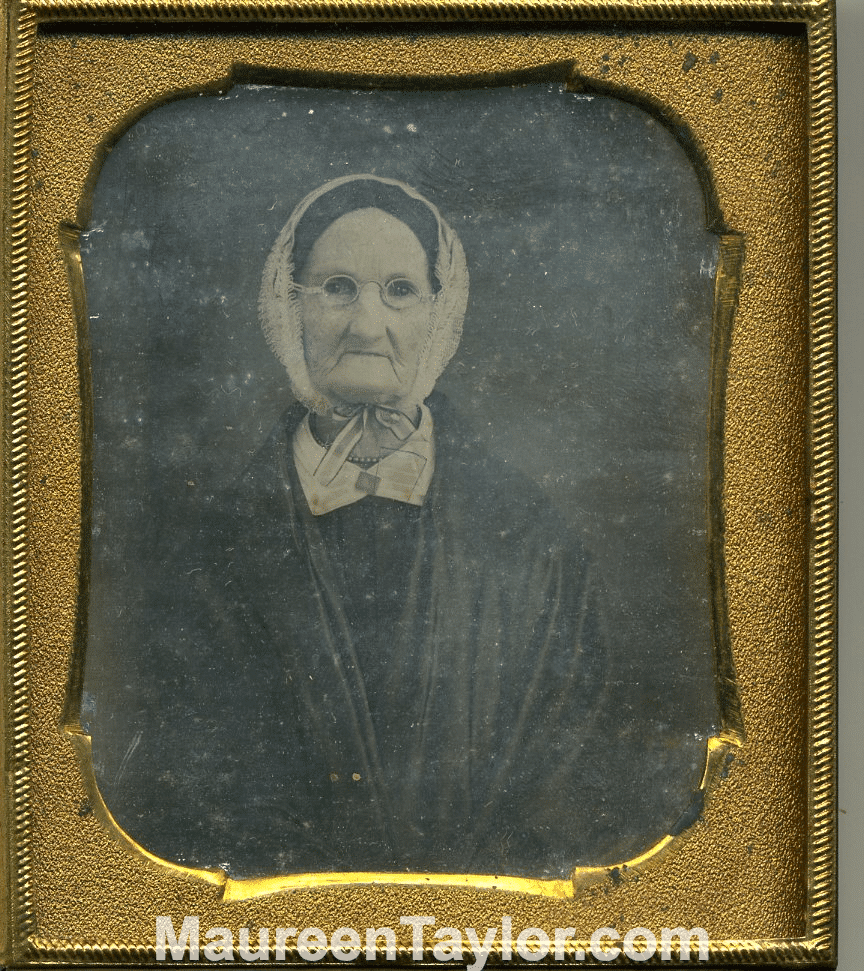
Hold the picture in your palm and look at it straight on. Can you see the image? If it’s shiny and reflective you’ll likely see yourself. Now hold it at a 45 degree angle. Better? Then it’s likely a daguerreotype. A type of picture on a silver coated copper plate.
Introduced in 1839 these likenesses stayed popular until approximately 1865. There is wiggle room in the end date.
Daguerreotypes are extremely fragile so don’t take the image out of the case. One touch can destroy it.
Ambrotype

If when you held the case in your hands you could see the picture it might be an ambrotype, a tintype or a card picture. Ambrotypes are on glass backed with a dark varnish. They have a flaw. When the backing begins to flake off you can see through parts of the picture. It can look like a negative with white areas.
Ambrotypes, patented in 1854, were widely available by 1856. The image of the woman in the green sweater is an ambrotype.
Tintype
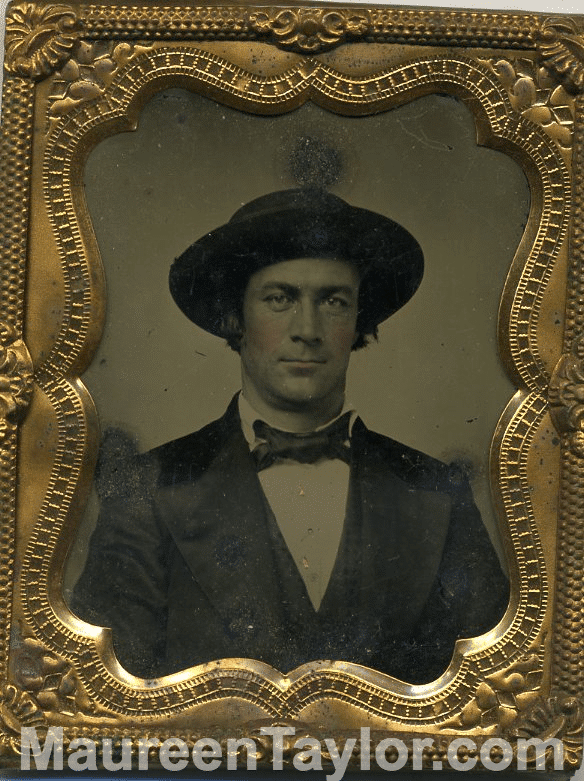
An ambrotype in perfect condition and a tintype in a case look a lot alike. Without removing the picture from the case use a magnet to see if there is an attraction. Tintypes are on iron plates making them magnetic. The tintype name reportedly refers to the tin shears used to cut the plates.
It’s more common to find ambrotypes and tintypes out of the case. That makes it easy to tell them apart. The latter is on glass and the former on a metal plate. Tintypes lack the shine of a daguerreotype.
Tintypes, patented in 1856, remained popular into the twentieth century. You’ll most often find these metallic images in paper sleeves or without protection.
Dating and identifying the person who sat for the image relies in part on the type of image. Getting that right can help you name the person in the picture. There is handy chart on telling images apart in my FAQ section.
For more information on how to recognize clues in a picture see The Family Photo Detective.