
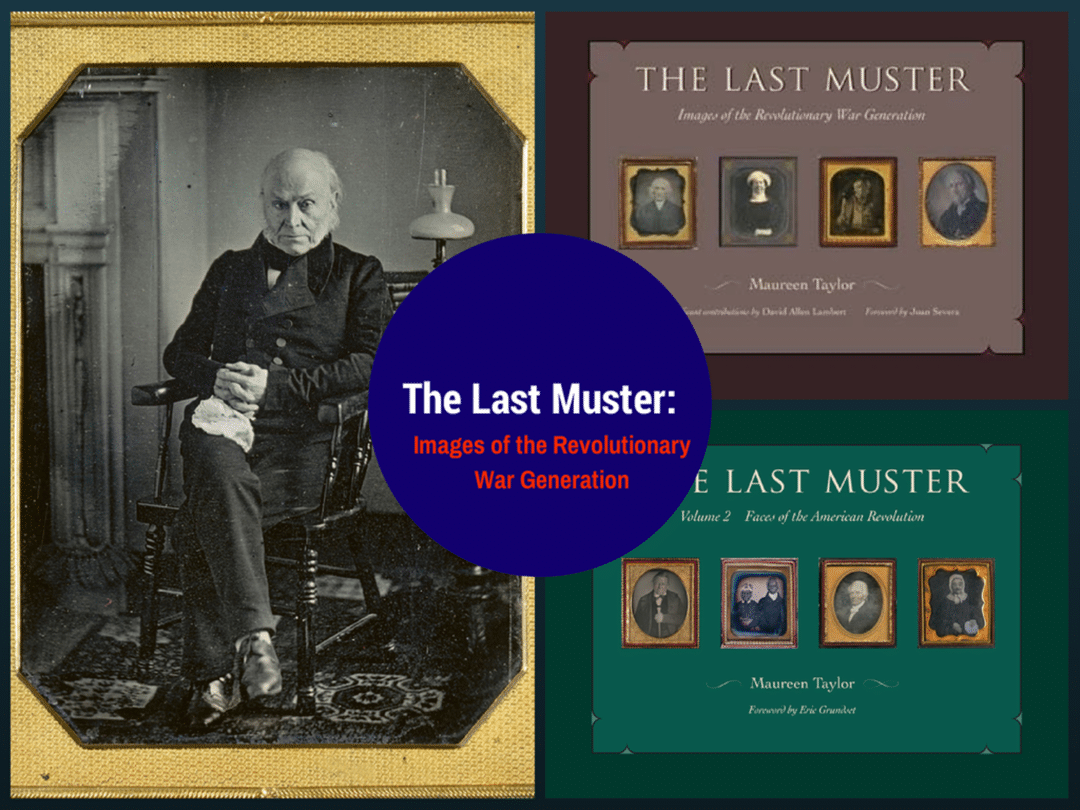
Twenty-five years ago, I held a daguerreotype in my hands and thought, “This man is old enough to have witnessed the American Revolution.”
The owner of the image confirmed that it was his ancestor, a Loyalist sympathizer.
That moment changed the course of my research.
What followed became The Last Muster Project, resulting in two books, an exhibit at the Concord Museum in Concord, Massachusetts, and inspiration for the final display at the Museum of the American Revolution in Philadelphia. It also led to three documentary films, including A Revolutionary Trio, produced by Verissima Productions, featuring Eleazer Blake of New Hampshire, Agrippa Hull of Stockbridge, Massachusetts, and Molly Ferris Akin of New York.
Over the years, I’ve written articles, given presentations, and spent countless hours searching for photographs of the men and women whose lives bridged the Revolutionary era and the dawn of photography.
Did I find all of them? Absolutely not.
In fact, I know there are many more images waiting to be discovered.
How do I know? Because readers, museum curators, librarians, and family historians continue to send me photographs and leads. Eric Grundset, formerly of the Library of the Daughters of the American Revolution, has been one of the most dedicated contributors. New discoveries continue to surface as collections are digitized, archives are opened, and families begin exploring boxes of inherited photographs.
The greatest challenge is not finding photographs. It’s identifying them.
Across the country, there are daguerreotypes without names, carte de visite portraits without labels, and family collections that have lost the stories behind the faces.
So how do you spot someone connected to the Revolutionary era in your own collection?
Start with the basics:
- A very elderly person in a case photograph, such as a daguerreotype, ambrotype, or tintype.
- A very elderly person in an early carte de visite.
- Family stories suggesting Revolutionary War service.
- Photographs linked to families known to have lived in America before 1800.
Of course, age alone isn’t proof.
The next step is verification. Is the person depicted a veteran, actually? A veteran’s wife? One of their children? That’s where research becomes both challenging and rewarding.
I rely on timelines to separate fact from family legend. Pension applications, military records, census schedules, probate files, and local histories can reveal remarkable—and sometimes heartbreaking—stories.
Occasionally, a photograph can even be matched to an earlier painting, engraving, or silhouette. What is unidentified in one collection may be fully documented in another.
Am I still looking?
Absolutely.
Will there be a third volume of The Last Muster?
I’m not sure.
At the moment, I don’t have enough newly identified likenesses to support another book, and publishing a volume would require starting the proposal process from scratch. The first volume took nearly a decade from proposal to publication.
As we commemorate the 250th anniversary of the founding of the United States, I find myself thinking about these men and women who witnessed the nation’s birth and lived long enough to see an entirely new age emerge. Their photographs connect us to history in a uniquely personal way.
Every identified face adds another piece to the story.
And somewhere, in an archive, museum, library, or family collection, there are undoubtedly more waiting to be found.
The Last Muster volumes are available through Amazon.