
So great aunt Mabel has finally decided that you’re the one. The person meant to care for family heirlooms including all those photos she’s been safe-keeping for the right descendant. You’re happy to have those boxes of pictures but at the same you feel like the figure in Edward Munch’s painting The Scream because of the sheer number of items she’s giving you and time constraints. Grabbing your head isn’t going to help.
 |
| Edward Munch’s The Scream |

Neither will listening to your inner voice saying I have too many pictures and not enough time. Before you panic step back from the problem. You’re not alone. It’s a common problem. Before you do anything think of that box as arriving in a genealogical emergency room and you’re the doctor that has to triage the items.
There are three things you can do to tackle that pile of pictures—interview Mabel, scan those pictures and file them away for safe-keeping.
As you begin the process, take a deep breath and realize that a family photo collection is indeed a responsibility. As genealogists we investigate the lives of our ancestors and those pictures are a key piece of the evidence of their existence. Throw them out? NEVER. Find them another home,
perhaps.
perhaps.
Take this pledge:
Step 1: Interview Mabel
If you’re lucky great aunt Mabel is still living. The first step is to try to make time for the two of you to sit down with that box of images. Bring your cell phone/ipad/tape recorder to record her thoughts. The goal is to try to get her talking about those pictures. If she’s hesitant about being recorded, try to reassure her that you can’t take notes fast enough and that you won’t be as accurate. Stress that it’s really important to hear in her own words her recollections of each image.
Take them out of the box one at a time, and see what she has to say. Before you start peppering her with questions about who’s in the pictures, where they were taken and why, let her speak. If she knew those people, she’ll start to reminisce about more than the single moment captured in that picture. She’ll tell you about life at the time the picture was taken.
To stay organized, write in light pencil with a soft lead (graphite or 6B) a number (1,2, 3….) in the upper right hand corner on the back of each one that she talks about. Mention that number when you’re interviewing her so that matching up the voice and the pictures isn’t a problem later. Keep those numbered images in order and separate from any leftovers.
Step 2: Scan as You Go
It may not be polite to scan at the time of your visit but it’s a good idea to scan each one after she talks about it. If you can bring along another family member to scan the pictures so that you can be attentive to the person being interviewed. Record information as you go so that you can later retrieve images and data.
Here are a couple of scanning rules.
- ·
Scan each one at a minimum of 600 dpi as Tiff files. Tiff is an uncompressed format and is considered the right choice for preservation. - ·
Enter all the information in a chart. You can use Word or Excel depending on what you’re comfortable with. This sample chart illustrates how to record the information.
|
Picture Number
|
Thumbnail of the image**
|
Identifying information
|
File name***
|
Who gave you the image
|
|
001*
|
Mabel Smith Jones m. 1930
|
001 Jones Mabel Smith b1915.tiff
|
Mabel Smith Jones
|
*The zeros will help sort your images in numerical order otherwise they get jumbled when you sort.
** include a 1 inch image of the picture compressed for file size
*** Keep file names simple. The image number, name of person with birth year
Step 3: Sort and File
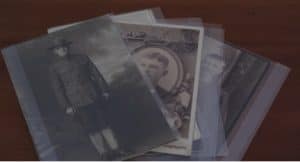
Each image should be placed in a polyester sleeve for protection. Store those sleeved originals in acid and lignin free boxes available from library suppliers. Keep mold out of your greater collection by storing any images that smell musty and appear moldy in a separate box.
Polyester sleeves and proper boxes can be purchased through library suppliers, but in some cases are available through vendors such as the Container Store. Shop around for bargains and buy in bulk to save money.
You’ll be surprised at how quickly you can move through a box of pictures if you follow these first three steps. You’ll find more organizing tips and budget minded storage advice in my Essential Photo Organizing course.
On days when you feel overwhelmed by all the “stuff” consider the alternative. Plenty of family pictures end up abandoned for lack of an interested relative ending up in the trash or an estate sale. Many families wish they had the picture legacy you’ve been handed.
Your great aunt Mabel chose you for a reason. She watched you grow up and followed your interested in family history. There’s at least one genealogist born every generation. Perhaps you’re the chosen one for your generation. Now your job is to care-take those goods until you spot your successor and groom them for the role.