
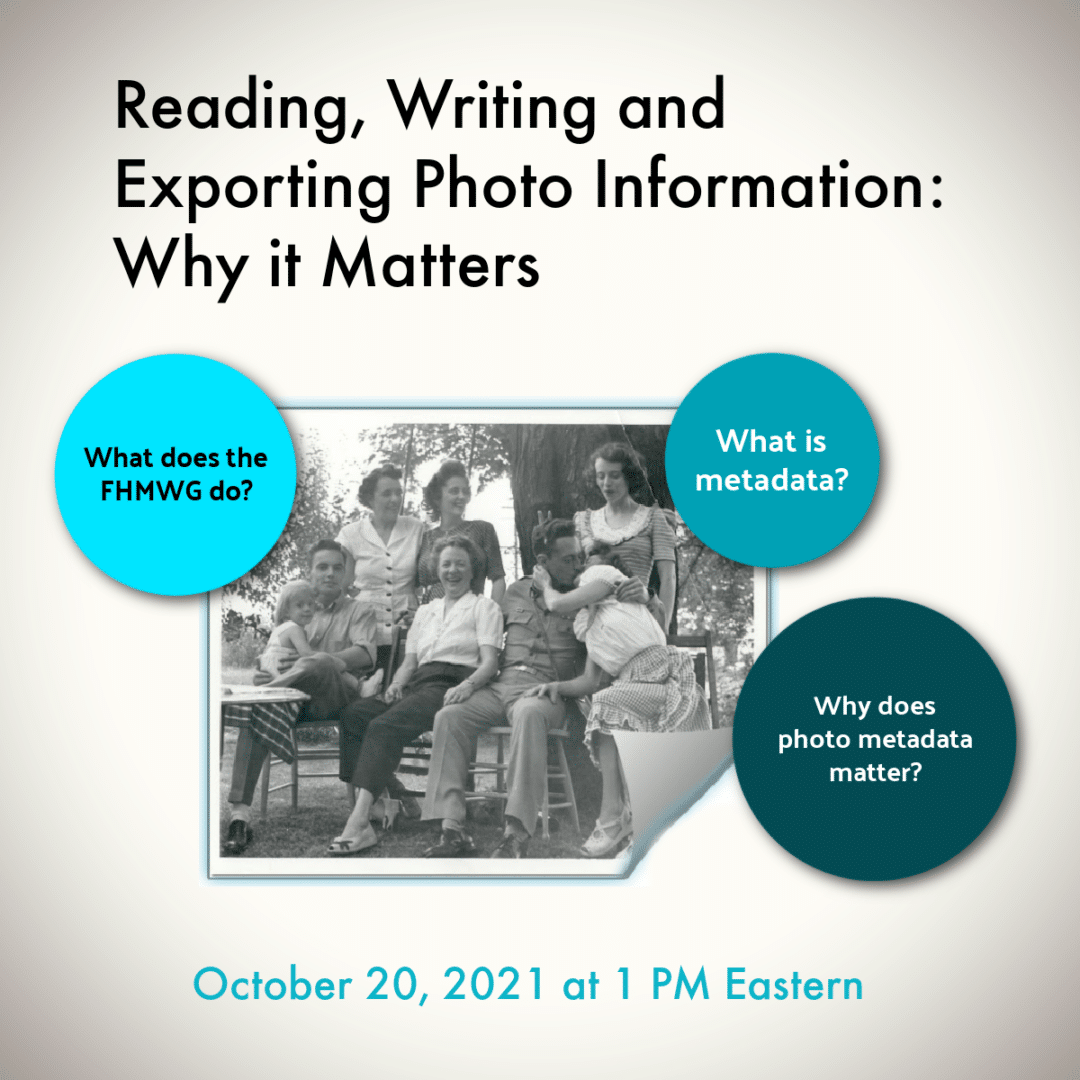
In today’s world companies are focused on business objectives, versus your personal archive and legacy. It’s important for you to know what’s available, what can be done, and what you can do to help ensure your legacy stays alive in your images. We’re unveiling the problem, the opportunity, and the solution.
While reading, writing, and arithmetic are the three cornerstones of education, there is a new trio when it comes to dealing with family photos. Writing, reading, and exporting metadata are essential components of any program or site that allows you to add images (photographs, scans, downloads). Metadata is information about the images–the names, places, dates, and more of your pictures. These components help you preserve your information so it can be used and read for the next generation. Unfortunately, not all sites or software are equal in their ability to do these three things. That’s where you come in and the Family History Metadata Working Group too.
All major image formats (e.g., jpeg, tiff, heif, png, raw, etc.) allow metadata to be embedded in the image file itself. However, many sites ignore metadata. Some even strip it out or override key pieces like a date. Take Google Photos for instance. You’ve added information to the digital file on your computer such as–caption, location, dates, and names. You upload pictures to Google Photos. Oops. It can’t read what you’ve embedded which means you can’t share it either.
Right now, the same is true for Ancestry.com, FamilySearch.com, and MyHeritage.com. You can add images, but support for embedded metadata is limited. Some display part of the metadata embedded in the images you upload, and some let you add metadata within their tool only, but most do not embed that data to the images themselves. This means the detail is lost (or not embedded) when you export the image or download it onto your computer. Adding extra details within those platforms doesn’t make sense if it’s not portable.
Join the Family History Metadata Working Group for a discussion of the metadata problem and how you can help.
- What is the Family History Metadata Working Group?
- Who’s in the group?
- What is metadata?
- Why it matters for family history?
- What are we trying to do?
- Why it matters?
- How you can help?
It’s a free interactive webinar
October 20, 2021 1 pm ET. REGISTER at https://www.crowdcast.io/e/metadata-2