
What happens when you use a photograph you already know well as a test case for ChatGPT?
I decided to find out.
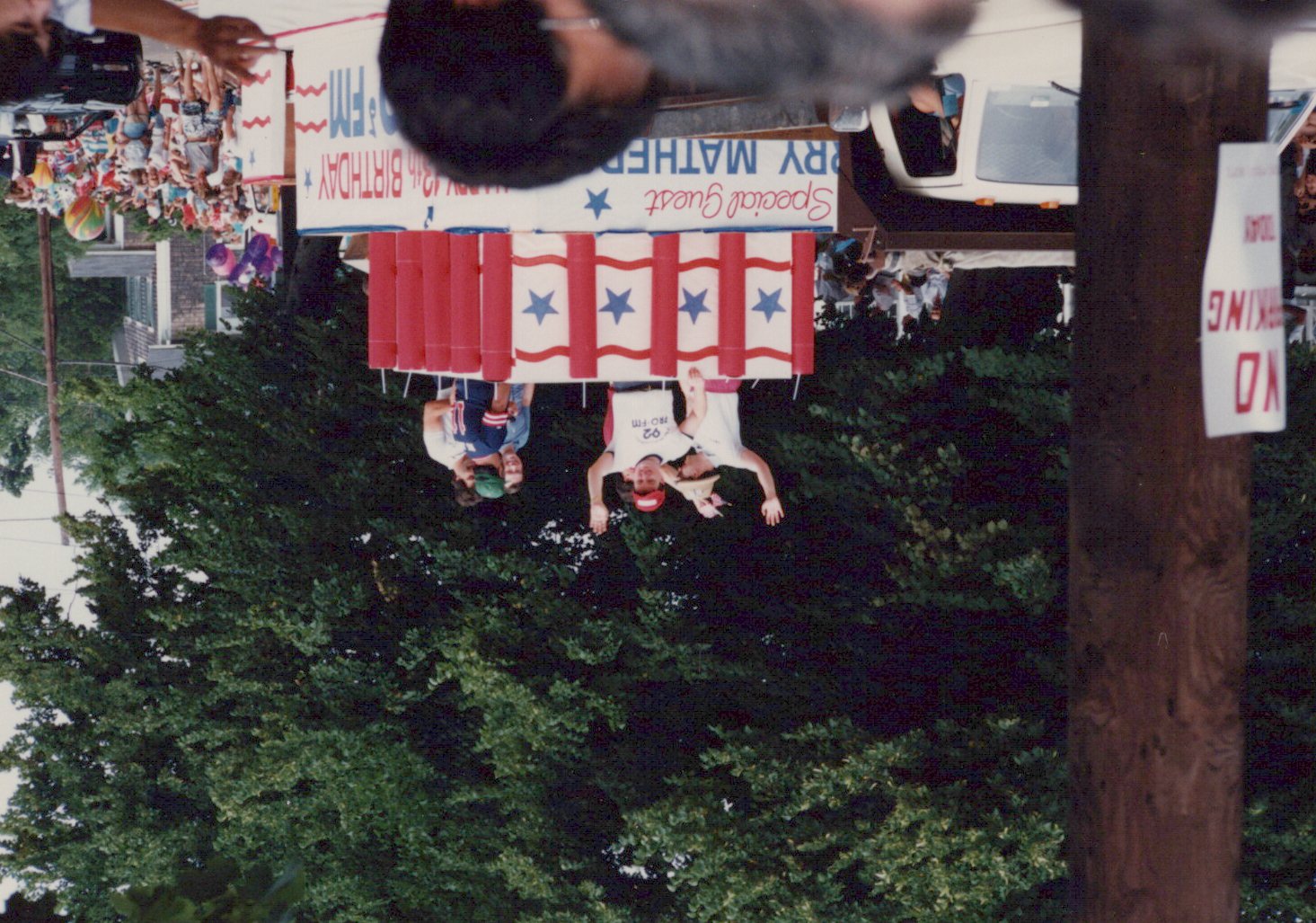
I uploaded a photograph I took during a Fourth of July parade. I was confident about when it was taken, where it was taken, and who was riding on the float. It seemed like the perfect image to see how well AI could interpret historical photographs.
It’s not a great photo. It’s blurry, and there were a lot of people in the way.
The results? Some were impressively accurate. Others were completely wrong.
What ChatGPT Got Right
The AI correctly identified several important details:
- The scene depicts a Fourth of July parade, complete with spectators lining the street and a float decorated in red, white, and blue.
- The float is designed to resemble a birthday cake with large red “candles” around the edge—a clever Independence Day theme.
- One participant is wearing a T-shirt with the logo 92 PRO-FM, a well-known Providence, Rhode Island radio station.
That last observation was especially useful. ChatGPT recognized that 92 PRO-FM frequently sponsored or participated in community events during the 1980s and 1990s, making the shirt a valuable clue for dating the photograph.
Where AI Went Off Course
This is where things became interesting.
The Date
ChatGPT noticed that the float appeared to include the words “236th Birthday.”
Since the United States celebrated its 236th birthday in 2012, the AI suggested the parade might date from that year.
The problem? Everything else in the photograph contradicted that conclusion. The clothing, automobiles, photographic quality, and even the construction of the float all pointed to the late 1980s, not 2012.
This is a perfect example of why genealogists and photo historians should never rely on a single clue. Every piece of evidence needs to be weighed against the others.
Who Was on the Float
The AI also attempted to read partially visible lettering on the side of the float. It interpreted the text as:
- “Special Guest”
- “Rory Matheson”
The first part was right, the second part was incorrect.
With only a few letters visible, ChatGPT essentially filled in the missing information with its best guess. That’s a common AI behavior called a hallucination—producing a confident answer that isn’t supported by the available evidence.
Verifying the Facts
Rather than accepting the AI’s conclusions, I turned to a contemporary source: the digital archive of the Bristol Phoenix.
The newspaper confirmed that the photograph was taken during the 1987 Bristol, Rhode Island Fourth of July Parade. The Grand Marshal was actor Jerry Mathers, beloved for his role as Theodore “Beaver” Cleaver in the television series Leave It to Beaver. The float was indeed sponsored by 92 PRO-FM.
The newspaper account verified what the photograph actually showed—and corrected the assumptions AI had made.
The Takeaway
This little experiment reinforced an important lesson.
AI is remarkably good at recognizing patterns, identifying objects, and suggesting research leads. It can notice details you might overlook and point you toward useful clues.
But it also fills gaps in the evidence. When text is partially obscured, or information is incomplete, AI may confidently invent details that sound plausible but are simply wrong.
For genealogists and family photo researchers, the best approach is to treat AI as a research partner—not as the final authority.
Use it to generate ideas. Then verify those ideas with contemporary records, newspapers, city directories, archival collections, and other reliable sources.
That’s still the heart of good genealogical research.